

What wholesale power and network charges mean for SME / MBU energy costs over the next 6–12 months
The short version. New commercial electricity contracts are about 25% higher than last September. Tracker energy-only rates are likely to rise a further 3–4 c/kWh from October into January — roughly +18–20% on the energy line. A winter Profile 5 all-in unit can still print in the high 30s c/kWh before VAT. The central case eases after March 2027.
| €168 All-island wholesale late September 2026 | ~25% New contract premium vs September 2025 | +18–20% Central winter lift on tracker energy |
| 19.0 c P5 24-hr tracker energy, Oct 2026 | 22.8 c P5 24-hr tracker energy, Jan 2027 | 9% Business electricity VAT rate |
Figures are drawn from the all-island wholesale market in late September 2026, published mid-market SME / MBU contract ranges, current DG5 / DG6 network pass-throughs, the PSO decision from 1 October 2026, and the system-operator adequacy assessment through 2028. This note is indicative planning material, not a live quote.
1. How SME and MBU electricity is priced
The energy line on a commercial bill is the only piece that moves with the wholesale market week to week. Network charges, the PSO levy and standing charges are regulated and change on published dates. The two load profiles that cover most SMEs are Profile 5 and Profile 6; the two distribution groups are DG5 and DG6.
| Class | What it is | Typical sites | What matters on the bill |
| Profile 5 — 24-hour | Non-domestic flat rate. MCC01. | Offices, retail, sites without a night meter | One energy unit rate. Highest blended energy if the site could have used night units. |
| Profile 6 — Day / Night | Non-domestic NightSaver. MCC02. | Hospitality, cold rooms, bakeries, sites with night load | Day rate is higher than P5; night rate is much lower. Needs ~30% night use to win. |
| DG5 | LV non-maximum demand | Most SMEs | Lower standing charge, slightly higher unit rates. |
| DG6 | LV maximum demand | Larger SMEs / MBUs | Higher standing and MIC capacity charge, slightly lower energy rates. |
Current mid-market published all-in ranges (ex VAT, late September 2026)
| Day / 24-hour | Night | Standing | |
| Small–medium (typical DG5) | 29.0–36.5 c (24-hr) / 31.5–37.8 c (day) | 19.5–24.5 c | €0.38–€0.99 / day |
| Larger MBU (typical DG6) | 28.1–33.5 c day | 19.5–23.9 c | €3.62–€6.75 / day |
| Energy-only (strip out network) | About 16 c below the day / 24-hr all-in | About 6.7 c below the night all-in | — |
New contracts written against today’s wholesale are landing toward the top of those bands. Energy-only — the line on the chart — is wholesale plus a small shape and retail adder.
2. Where wholesale sits now
The all-island day-ahead market is near €168/MWh (16.8 c/kWh) in late September 2026. August averaged about €171/MWh. A year earlier the same market was closer to 9.4 c/kWh. Gas is still the price-setting fuel on tight Irish evenings, so the gas shock since March is already inside the power price.
| Marker | Level | Why it matters |
| All-island wholesale, late Sep 2026 | €168 / MWh (16.8 c/kWh) | Anchor for new tracker energy rates |
| August 2026 monthly average | €171 / MWh | Already a winter-like print in late summer |
| New commercial contracts vs Sep 2025 | About +25% | What a site coming off contract actually pays |
| System adequacy 2026–2028 | Outside the reliability standard | Tight winters keep a risk premium in the curve |
| PSO from 1 October 2026 | €1.93 / month if MIC < 30 kVA; else €0.24 / kVA / month | Small, regulated, not the driver |
Winter cases. Central path: tracker energy-only up 3–4 c into January. High band: cold, still weather plus a further gas shock — wholesale into the mid-to-high 20s c/kWh for a period. Low band: mild winter and easing fuel markets. Upside risk is larger than downside risk this winter.
3. Indicative path, October 2026 to September 2027
Energy-only, c/kWh excluding VAT. Network, PSO, standing, capacity and VAT sit on top.
| Series | Oct 26 | Jan 27 | Jun 27 | 12-m avg |
| Wholesale (central) | 17.6 | 21.4 | 13.6 | 17.1 |
| Profile 5 — 24-hour tracker | 19.0 | 22.8 | 15.0 | 18.5 |
| Profile 6 — Day tracker | 19.8 | 23.6 | 15.8 | 19.3 |
| Profile 6 — Night tracker | 12.9 | 15.3 | 10.4 | 12.6 |
| Profile 5 — 1-year fixed booked now | 19.6 | 19.6 | 19.6 | 19.6 |
| Profile 6 — Day 1-year fixed | 20.4 | 20.4 | 20.4 | 20.4 |
| Profile 6 — Night 1-year fixed | 16.4 | 16.4 | 16.4 | 16.4 |
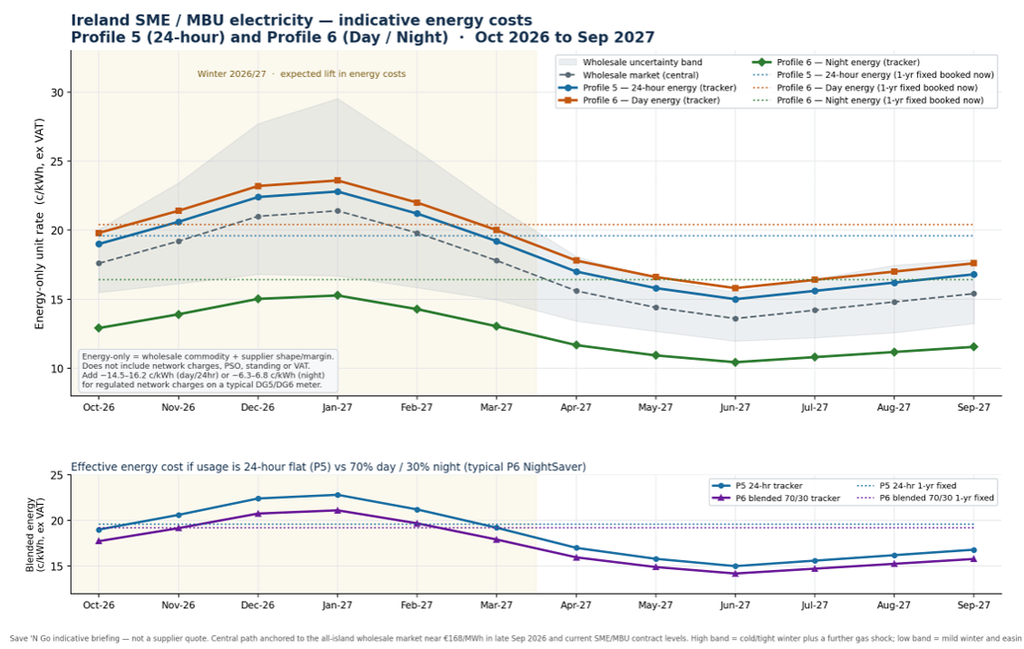
Grey band = wholesale uncertainty. Solid lines = tracker energy. Dotted lines = a 12-month fix booked now. The lower panel blends Profile 6 at 70% day / 30% night against a flat Profile 5.
4. What sits on top of the energy line
- Network pass-through, current DUoS year: about 14.5 c on a DG5 24-hour unit, 16.2 c Day, 6.8 c Night. DG6 Day about 12.5 c and Night about 6.3 c. The next network year may reset these.
- Standing charges: DG5 about €0.39–€0.99/day. DG6 about €3.62–€6.85/day, plus a capacity charge on MIC.
- PSO levy from 1 October 2026: €1.93 per month if MIC is under 30 kVA, or €0.24 per kVA per month if MIC is 30 kVA or higher.
- VAT at 9% on business electricity. Not inside the c/kWh figures above.
- All-in winter illustration: a Profile 5 tracker in January can still print in the high 30s c/kWh before VAT even though the energy line itself is only in the low 20s.
5. What this means if you come off contract this winter
A tracker will print the winter spike and the summer ease. A 12-month fix booked now locks a winter-weighted energy rate near 19.6 c (Profile 5) or 20.4 / 16.4 c (Profile 6 Day / Night). That looks cheaper than a tracker through January and more expensive than a tracker if the central case plays out next summer. Two-year locks at this forward curve are hard to justify unless the site needs budget certainty above all else.
Profile 6 still beats Profile 5 on the blended energy line once night use is around 30% of annual kWh. Below about 25% night use the higher day rate often cancels the saving. DG6 energy is typically 0.4–0.8 c below the equivalent DG5 energy rate, offset by standing and capacity.
Practical order of work. 1) Confirm DG5 vs DG6, Profile 5 vs 6, MIC and % night. 2) Do not break a fixed contract that runs past March 2027. 3) If you renew this winter, budget energy-only in the high teens to low 20s c/kWh and all-in day / 24-hour units in the mid-to-high 30s before VAT. 4) Price on-site solar against actual day units. 5) Prefer a short fix or a tracker over a long lock at today’s winter-weighted curve.
Sources and disclaimer
All-island wholesale levels current at late September 2026. Mid-market SME / MBU contract ranges current at 23 September 2026. Published DG5 / DG6 network pass-throughs for the current DUoS year. CRU PSO decision effective 1 October 2026. System-operator generation-adequacy assessment 2026–2035. Winter scenario ranges informed by fuel-market and adequacy conditions. No supplier is named in this briefing.
Save ’N Go · Nationwide service, Ireland & NI · info@savengo.ie · savengo.ie. Indicative market view as at 24 September 2026. Not a tender, a guarantee of future prices, or regulated financial advice. Commercial electricity is individually quoted against MPRN, MIC, profile and 12-month consumption.
